Naomi’s Flawed Masterpiece
 My friend Naomi Hirahara talks today about her affection for Summer of the Big Bachi, her widely acclaimed first novel and today's Top Suspense Sizzling Summer read. It took her fifteen years to write the novel, which she considers "a flawed book yet a very ambitious one" and yet her favorite among all the ones that she's written:
Why do I describe my first novel as flawed? This is not a finely tuned mystery novel, as sits probably in the middle of being a traditional mystery and literary fiction. Mas is very broken in this novel and not that likable at times. And I use a lot of dialect.BACHI, for instance, means “what goes around, comes around.”
I feel that SUMMER OF THE BIG BACHI captures a community of people that you probably never knew existed. They have survived and thrived through experiences you couldn’t imagine. This summer, spend a few days in Mas Arai’s world. It will be a fresh, and unique experience and probably one you won’t forget.
She's right. Discover for yourself why so many booksellers fell in love with this book and hand-sold it to big and lasting success.
Harlequin Screws Authors
Amazon gives authors a 70% royalty when they self-publish an ebook. On the other end of the spectrum, the standard ebook royalty set by most major publishers is 25%, one that the Authors Guild says massively screws authors.
But Harlequin is setting a new low.
Dear Author,
The landscape of digital publishing continues to evolve at a fast pace and Harlequin is at the forefront of this evolution. In 2007 Harlequin was the first publisher to simultaneously publish print and digital editions of our entire frontlist. Since then we have also digitized and brought to market our backlist and now have a current catalogue of over 11,000 ebooks!
The Harlequin brand has always offered an advantage other publishers don't have and this is especially true for ebooks. Our digital marketing efforts focus on building the Harlequin brand to drive the sales of your books through newsletter programs, advertising, search engine marketing, social media properties, the Harlequin website and leading ebook retailers. All this means better search and discoverability by online shoppers and an endorsement of the quality of the read, which is critical in the midst of the online clutter.
Harlequin has been closely monitoring developments in digital publishing, including author compensation. As you know, until now Harlequin's position has been that digital royalty rates as a percentage of cover price is a more transparent way to pay authors than as a percentage of net receipts: authors know exactly how many copies they sold at what price and their compensation is not affected by unspecified costs. Over the past several months we have worked to ensure a smooth transition from the current percentage of cover price calculation to a net receipts calculation while maintaining the same transparency. As such, Harlequin will be amending digital royalty rates.
Effective January 1, 2012, series authors who are actively writing for Harlequin will receive a digital royalty rate of 15% of net digital receipts for each digital unit sold in the English language, United States and Canada, frontlist and backlist. This will include books in Harlequin's digital backlist program, Harlequin Treasury.
Given that these are more favorable terms than those in your existing contract(s), this notification will be considered the amendment to those contract(s). If you wish to maintain the existing terms of the contract(s), please let us know by Friday, July 15th, 2011.
The Mail I Get
I could write a book on how to communicate ineffectively just by sharing the emails that I get. Here's one that I got today, with the subject "Books":
I run a book review blog. I was wondering if you would be willing to send me a copy of your latest Monk book in return for a review on my blog. Please contact me with your response. Thank you.
Sent from my iPhone
Hell of a pitch. Would have been even better if the dimwit thought to include the name, or perhaps even a link, to his blog. I also got this email from someone named "E. Belmont" with the subject heading "New TV Show Idea."
I would like to speak to you asap feel free to email me back or call me at 917-XXX-XXXX or 913-XXX-XXXX ok…?
Sent from Yahoo! Mail on my Android
Wow, who wouldn't drop everything he was doing, pick up the phone right away and make a long-distance call to a complete stranger after such a compelling pitch like that? What are you smoking, E. Belmont?
Tied In to Writing

For the last few weeks, author Jonathan Maberry has been running a terrific series of lengthy, detailed interviews with Scribe nominated tie-in writers on his Big Scary Blog about the nuts-and-bolts of their craft. This week he focuses on the authors nominated for "Best Speculative Original." Here's an excerpt:
BIG SCARY BLOG: Talk about your process for creating a media tie-in book.
MATT FORBECK: If I’m not already familiar with the basis of the book, I immerse myself in it as best I can and become a fan of it too. As I do that, I look for story hooks, little “what about that?” or “wouldn’t that be cool?” bits. Those become the seeds of the novel. Once I have that, I write up an outline, get it approved, and dig in for real.
JEFF GRUBB: I think all media projects have a core ethos, an underlying truth about them. The original creators of the project may not know what it is, and in fact it may evolve over time. One of the goals I have when working on a media tie-in book is to dig down and find that piece, find that core ethos, and remain true to it in the story. Guild Wars 2 is very much about people coming together to fight a greater threat – that is one of Dougal Keane’s major conflicts in the book.
DAVID MACK: It’s a lot like most other writers’ processes, I imagine. Either I solicit an editor for a shot at writing for a particular license, or they approach me. Either way, if it’s a property I know well, I might already have ideas ready to pitch and develop. If it’s one that I’m curious about but don’t know intimately, I’ll dig in and immerse myself in it until I start to get a feel for its big picture, its characters and its broader storytelling arcs.
Next, I’ll try to find a story that interests me and seems to offer some new angle that neither the show nor its existing tie-in titles have explored. In some cases, such as a tie-in line that’s been running for a while, an editor might ask me to craft a story specifically to advance a part of an ongoing narrative.
Then I write a proposal, just a few pages, to see if my general idea is what the editor is looking for. Once we settle on an idea, I prepare a much longer and more detailed full outline that can be presented to the license-holder for approval. Once we get the green-light, I go to work on the manuscript.
To stay in the right mindset while working on a given franchise, I’ll try to listen to music soundtracks from it (if they’re available), and have DVDs ready for reference and quick refreshers on characters’ speech patterns, etc. Online references are also often invaluable tools, especially for a series that is still in production while one is working on it. Thank Heaven for the invention of wiki reference sites!
SEAN WILLIAMS: Well, firstly, I have to make sure I know the property sufficiently well to do it justice. With Star Wars or Doctor Who, say, that would be easy: I’ve been a fan of them for decades. Depending on the kind of project, the next step would be to get right down into the details of the story and character, since they’re the aspect of the tie-in most important to get right, at least in the early stages. This is always accomplished in collaboration with editors and other stakeholders in the project–the people who own the property, basically. I’m not just telling a story for me: in a real way I’m just channelling something for someone else. But that is a fun process, and a challenge, one I take very seriously. There are snafus sometimes, without a doubt, but whether I have one month or one year to write a tie-in, I give it the same energy and consideration I would give one of my own books. To do anything less would be to cheat everyone involved.
The entire series of interviews is well worth your time, regardless of whether you are into tie-ins. There's a lot of great insights into the craft and business of writing books shared by the authors, all of whom are experienced, hard-working pros.
Sizzling Summer Reads
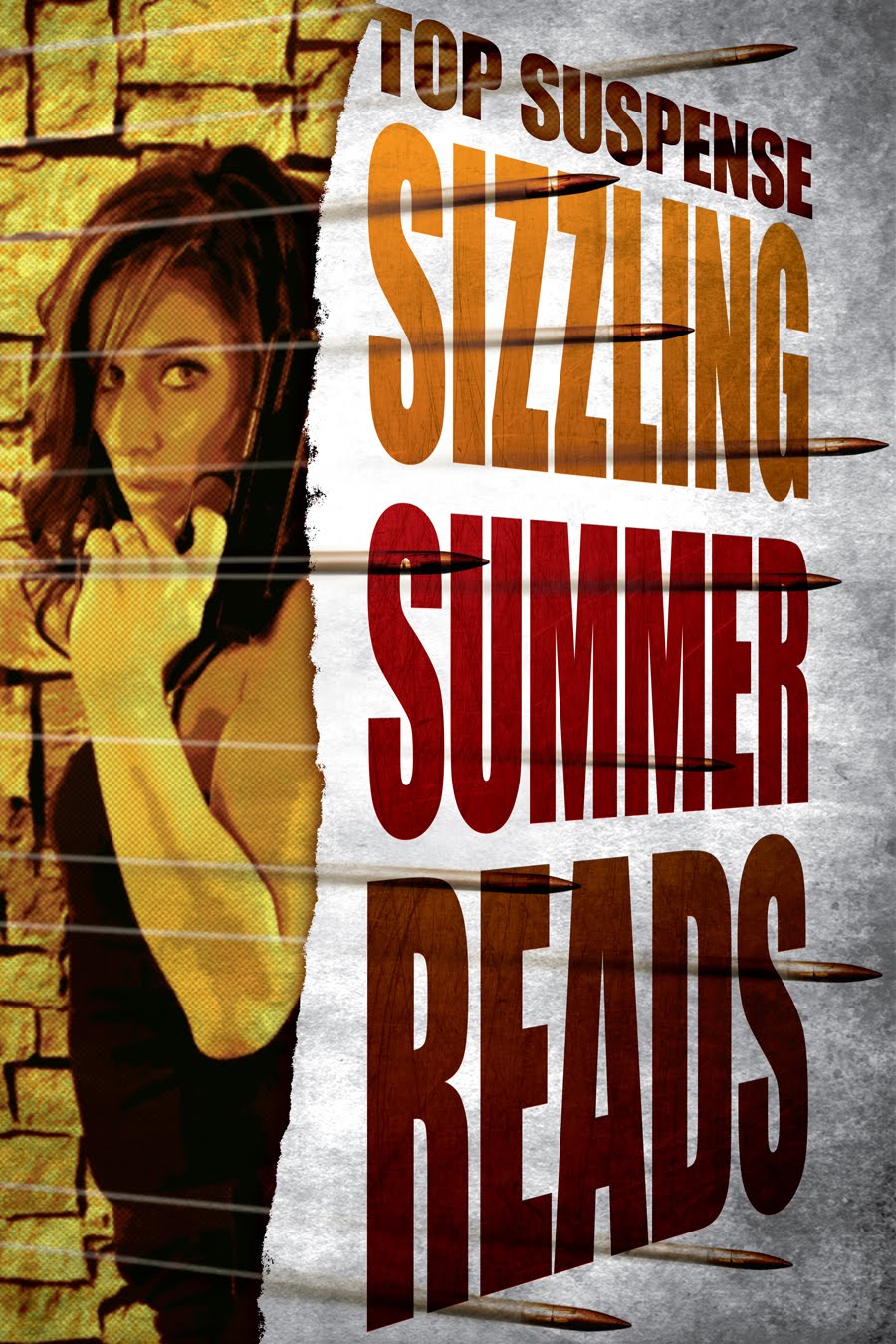 It's going to be a long, hot Top Suspense Summer! Here 12 masters of the genre will keep you on the edge of your beach towel with 12 sizzling summer reads guaranteed to get your pulse pounding.
Join in the discussions this summer and win a free copy of our second anthology! With our second Top Suspense anthology we’ll each be contributing an award nominated, an award winning, or a personal favorite story. It will be out in the Fall, and anyone who reads and joins in the discussion on our Facebook page of four of our summer books–or better yet, reviews the books on Amazon–will receive a free copy before we make it available to the general public.
Watch the Top Suspense blog over the next three weeks as each Top Suspense author will talk about their sizzling summer books.
Blood Dreams by Jack MacLane (Bill Crider)
Dying Memories by Dave Zeltserman
Motion to Kill by Joel Goldman
No One Will Hear You by Max Allan Collins & Matthew Clemens
Set The Night On Fire by Libby Hellmann
Summer of the Big Bachi by Naomi Hirahara
Valley Of Lights by Stephen Gallagher
Voluntary Madness by Vicki Hendricks
And Watch Me Die by yours truly. And don't forget to join our Summer Sizzling Reads discussions all summer long at our Top Suspense Facebook Page!
TV Main Title of the Week
The secret shame I share with Jessica Alba. We both worked on this show (this is from the airings in France, where it was undoubtedly a cult hit).
Thriller Breasts
 A few years back, I remember reading that Homeland Security was inviting thriller writers over to give them advice on what plots terrorists might be cooking up. The notion was widely lampooned but it was probably a very smart idea, because as author Lew Perdue points out, when it comes to terror plots, he's often been way ahead of the curve, especially when it comes to killer breasts:
The Obama Administration’s recent warning about terrorists using breast implant bombsreminds me that over my 35 years of writing thrillers, I’ve frequently developed ideas — including explosive breast implants — that once seemed preposterous, outlandish or impossible — but which have either come true or entered the realm of the dangerously likely.
[…]About two year ago, I outlined a thriller around women who had implants filled with a liquid explosive that does not require a separate detonator to explode. Nitroglycerine is an example one of these, but is less stable and not as powerful as alternative formulations available. […]I had stunningly attractive women with breasts surgically enhanced to Brobdingnagian proportions, which of course, require commensurate structural support including a substantial underwire superstructure.
The detonation mechanism consisted of two parts, both cleverly constructed to identically mimic bra underwiring. The actual detonator circuit was contained in side the implant was a simple variation on a spark gap. This was capacitance linked to external wiring in the bra. The connection as I designed it in the outline was a bit like those capacitance switches that work when you touch them with your finger. No direct connection is needed.
Similarly, the electrical charge to initiate the detonation in the breast implant bomb doesn’t need a direct connection. Just the closeness through the skin between the detonator and the electrical charge to set off the explosive. The electrical charge in my thriller outline came from a small netbook which had been rewired to route the power leads of the USB port to the earplug port. Very large capacitance charges can be achieved by gradual charging. But the advantage of a capacitor is that t can discharge all its energy almost instantly.
By bringing the slightly modified earplug near the implanted detonator wire and pressing the “PLAY” button on the netbook’s music player would detonate the implants.
What Royalty Should Publishers Pay Authors For Ebooks?
Publishers maintain a 25% royalty on ebooks is generous but the Authors Guild thinks it should be 50%. Author Kelly McClymer's thoughtful husband has crunched the numbers and determined what he believes, based on industry figures, what he thinks the fair royalty should be. He goes into great detail about how he determined those numbers, and it's truly fascinating to read, but here's the bottom line:
25% net is much too low a royalty rate, a 50% net is too much as it assumes no cost to the publisher and is not realistic. […] Ebook royalties should be between 31.4%and 45% of net. The lower royalty rate assumes publishers have the same cost to publish an ebook as a paperback while the 45% has a more reasonable cost.