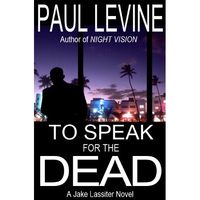
My buddy Paul Levine has brought To Speak For the Dead and Night Vision, the first two books in his acclaimed and beloved Jake Lassiter series, back in print in new Kindle editions. The rest of the books in the series will soon follow. These books are a steal at $2.99… and all the proceeds from the sale of To Speak For the Dead will go to the Four Diamonds Fund, which supports cancer treatment for kids at Penn State Hershey Children’s Hospital. So what are you waiting for?
Current Affairs
Tripping Through My Past
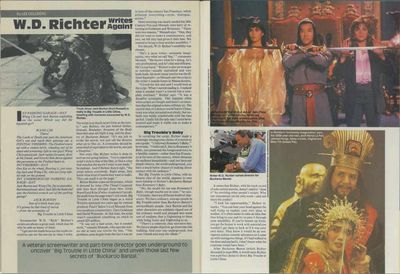
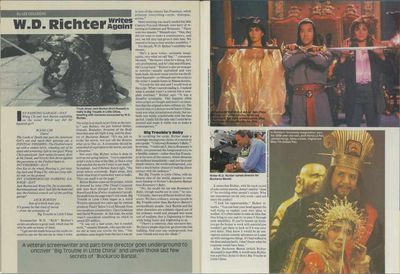
Thanks to John Zipperer's blog, I've been able to time-travel into my past through the articles I wrote for STARLOG magazine in the 1980s. John has been cataloging every single issue of STARLOG's run. Each of his blog posts inevitably brings back memories. There are many interviews that I've done that I've forgotten all about, like the one above with screenwriter W.D. Richter on the set of Big Trouble in Little China and one that I did with George Lucas (how could I forget that?). I am also astonished by how hard I worked. I often wrote three or more articles per month. For instnace, in one issue, I had interviews with Kurt Russell, Martin Landau, and director Tobe Hooper..and in another I interviewed Bob Gale, Ray Bradbury, and Kim Cattrall. It's also interesting to see the wide assortment of people I talked to… directors, actors, producers, screenwriters, novelists, special effects experts. But it's clear to me that I was more interested in the writing of the movies and TV shows that I covered than anything else. No surprise there. It's also amusing for me to see how many of my UCLA Daily Bruin buddies (William Rabkin, Brian Lowry, Marc Weinberg), girlfriends (Karen E. Bender), and family members (my mom!) I talked into working for STARLOG, too.
Wiley Royalty Grab
An important warning from The Authors Guild:
Wiley's Deceptive Letter to Bloomberg Press Authors: "We are pleased to inform you" that we will be slicing your royalties up to 50%
John Wiley & Sons acquired Bloomberg Press, the books division of Bloomberg, in March. At the end of April, it began sending a letter to hundreds of Bloomberg Press authors purporting to inform them "about a few differences in the accounting systems of Bloomberg and Wiley that it will be helpful for you to know about."
While this sounds innocent enough, it isn't. If signed by an author, the letter is actually a contract amendment that will materially and adversely affect the royalty rates of many Bloomberg Press authors.
Among other things, this contract amendment would:
1. Change royalty rates based on retail list price to rates based on net receipts. We've reviewed several Bloomberg Press contracts. All provide for royalty payments based on the retail list price (although we understand that there may be many based on net receipts). The Wiley letter misleadingly presents this to the author as good news: "We are pleased to inform you that we will be paying your royalties on the net amount received…" This change will, for many authors, effectively slice royalties by up to 50% for some book sales. Wiley's letter fails to disclose that.
2. Empower Wiley to keep an author's book in print with a lowball print on demand royalty of 5% of net receipts. (Bloomberg Press had no print on demand program.) The contract amendment, which provides no threshold level of sales for a work to be considered in print, essentially grants Wiley a perpetual right in an author's book for a pittance. The 5% of net receipts royalty rate for print on demand editions is as low as we've seen.
We've asked an independent royalty auditor to review the affects of these contractual changes on royalty income. The royalty auditor found reductions of 24% to 43% using actual sales figures and applying Wiley's amendments. (The precise affect of the amendments will vary by title, depending on particular categories of sales of the work.)
The Authors Guild strongly urges Bloomberg Press authors to not sign this letter without careful consideration. If you have received this letter, consult your agent or a publishing attorney or contact a lawyer in our legal department so you understand precisely how this amendment would affect your rights and royalties. Important: if you have already signed the letter and returned it to Wiley, contact our legal department immediately. Non-Guild members are welcome to contact us as well. All communications will, of course, be held in confidence.
This is no way to do business. The letter is shocking from a publisher of Wiley's stature. In our view, Wiley should tear up any signed letters it has received and start over, forthrightly explaining to its new authors the contractual changes it is seeking and how this may affect their income and their right to terminate their publishing contracts.
Two Crooks Elmore Leonard Would Appreciate
I absolutely loved the story in today's LA TIMES about the insider trading scam cooked up by an inept Disney secretary and her dimwit boyfriend, both of whom could be characters in an Elmore Leonard novel.
The Disney secretary, Bonnie Hoxie, and her boyfriend, Yonni Sebbag, sent anonymous letters to three dozen hedge funds offering them an advance peek at the Mouse House's quarterly earnings report. The hedge funds immediately called the Feds, who sent a couple of undercover agents out to make a deal with Hoxie and Sebbag.
Federal authorities arrested the couple early Wednesday morning and charged them with criminal wire fraud in what experts described as one of the more ham-handed attempts at insider trading in memory.
[…]Sebbag told undercover agents that he was "looking to build a strong business relationship" and that "I don't think we will get caught if we stay discrete [sic] and careful."
[…]Sebbag allegedly said he wanted "to make a lot of money" and asked for their guidance in opening an offshore bank account to avoid detection.
[…]"This is the insider trading equivalent of the bank robber who drops off the demand note and comes back in an hour to pick up the money," said Robert A. Mintz, a former federal prosecutor who is a partner at McCarter & English in Newark, N.J. "It's mind-boggling that somebody would even try to get away with something like this."
When the Illiterate Rule
Garrison Keillor fears for the future of book publishing in this new age where anybody can be "published." He says, in part:
Call me a pessimist, call me Ishmael, but I think that book publishing is about to slide into the sea.[…]if you want to write, you just write and publish yourself. No need to ask permission, just open a website. And if you want to write a book, you just write it, send it to Lulu.com or BookSurge at Amazon or PubIt or ExLibris and you've got yourself an e-book. No problem. And that is the future of publishing: 18 million authors in America, each with an average of 14 readers, eight of whom are blood relatives. Average annual earnings: $1.75.
He's right. Anybody can "publish" a book now, whether they can write or not. I got some evidence of that today. Several prominent authors have been spammed by a self-published "writer," and I use that term very lightly in this case, named Irene Matthews. Here's her note:
Hello how are you? PublishAmerica will be at the book expo with many book's from new author's my book will be among them. Title Dark Island by Irene Matthews. It's a pirate adventure like no other before it with twist's and turn's and an ending that no one saw comming, enjoy.
At first I thought the email had to be a fake, but then I saw the listing for her book at PublishAmerica:
I have been writing since I was 13 years old and really enjoy writing. I write poems, love stories, horror, adventure, etc. All my life I always wanted to write a wonderful book and finally my dream has finally came true thanks to alot of wonderful people who believed in me. I knew one day that my dream would come true one day, and to never ever give up. Since I was little I always had a love for pirate movies and stories, plus I always loved vampire stories and movies, I also believe dreams do come true and mine did come true.
If anybody ever needed proof that PublishAmerica is a scam, or that there's good reason for Garrison Keillor's fears, the publication of this book is it.
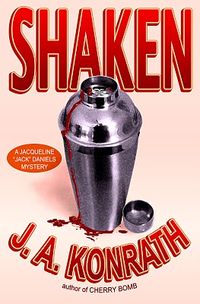
SHAKEN Shakes Things Up
Joe Konrath is breaking new ground on the e-front yet again. Today Amazon announced that Amazon Encore is publishing SHAKEN, his latest Jack Daniels novel, first as a $2.99 ebook in October and then as a traditional trade paperback in February 2011.
Up until now, Amazon Encore has only reprinted books that didn't make a big splash in their initial release and had fallen out of print. This is the first time they are publishing an original novel.
Joe took the deal after Hyperion dropped the Jack Daniels series and no other publisher stepped up to publish the new book…and after his extraordinary success selling his other unpublished manuscripts as ebooks on Amazon.
There's no doubt Amazon has noticed how well Joe's books are doing on the Kindle. From their POV, this deal had to be a no-brainer (though I suspect they would have liked to charge more than $2.99 but less than $9.99 for the ebook). It certainly was a no-brainer from Joe's side. On top of that, Amazon will find no better cheerleader for the Kindle than Joe, which should lift up sales of all Kindle titles across the board as he works tirelessly to promote SHAKEN. In the Amazon press release, Joe says:
“My Kindle readers have been incredibly faithful fans and I’m excited to be able to release the Kindle edition of ‘Shaken’ several months before the physical version is available to purchase,” said Konrath. “Since it’s easier, faster and cheaper to create an e-book than it is a physical book, Kindle owners will get to read the seventh Jack Daniels before everyone else. The ability for authors to reach fans—instantly and inexpensively with a simple press of a button—is the greatest thing to happen to the written word since Gutenberg.”
He elaborated in on the deal, and why he took it, in more detail on his blog. He said, in part:
Traditional publishers had a chance to buy SHAKEN last year. They passed on it. Their loss. Their big loss. Their big, huge, monumental, epic fail.[…] I signed a print deal with a company that can email every single person who has every bought one of my books through their website, plus millions of potential new customers. I've never had that kind of marketing power behind one of my novels. I'd be an idiot not to do this.
I think it was only a matter for time before Amazon reached out to Joe to aggressively capitalize on his success instead of passively (they have been getting the lion's share of the money on his ebooks by doing nothing but hosting him).
Joe is calling this deal a defining moment in publishing and so are his many fans. I'm not so sure that I'd go that far, but it was certainly inevitable. I think the only real difference between what Joe has been doing up with his ebooks and this Amazon Encore deal is that now he will have the full promotional might of Amazon behind him. As an e-venture, this will surely be a massive success, but as a print-publishing venture, I am not so sure. There's no doubt, though, that it's a win-win for Joe, who is bound to see the sales of his current slate of ebooks skyrocket as a result of the Amazon push for SHAKEN (including, ironically, the books still held by Hyperion).
UPDATE 5-18-2010: I woke up this morning to a bunch of emails asking me why this is a significant development in publishing. How is this any different, they ask, than what Joe is already doing self-publishing his unpublished work on the Kindle?
In essence, Amazon Encore is a publisher that has picked up Joe's mid-list series from Hyperion. They are publishing the book first as an ebook then later as a trade paperback. The difference here is that the publisher is also the largest bookstore on earth and will put their considerable promotional and marketing might behind his book. But there's a bit more to it than that. Here's how Joe explained it in the comments section of his blog post:
"In this case Lee, it's a bit more complicated.
This bookseller is the number one online bookseller in the world, and they've created the number one dedicated ereading device.
Publishers need authors to write books, then booksellers to sell those books.
In this case, Amazon owns the bookstore, and the platform for the ebooks. And by cutting out distributors, publishers, and brick and mortar bookstores, they can offer a professional product faster and cheaper–and give the author better royalties–than a traditional publisher could.
In other words, Amazon is cutting out just about all the players in the traditional publishing industry, and directly connecting reader with author.
If ebooks, and Amazon, continue to gain popularity, will there still be a need for the Big Six? Or would authors do better by either self-publishing, or dealing directly with the sellers of the new technology? I think this is pretty significant in the publishing world."
UPDATE: Jason Pinter, author and former editor, shared his worries on The Huffington Post about what this deal means for the future. He said, among other things:
Amazon and other online retailers have made it incredibly easy to publish books on their servers. They give each author the ability to format books price them how the authors themselves see fit. There is certain freemarket sensibility here that is inspiring, and in a way each author becomes the proprietor of their own small business. However, I feel that the example of Konrath will inspire other, less successful and even less talented authors to publish their works online. They might see the Kindle as a bypass, a way to showcase their works that the Evil, Stupid Publishing Overlords in New York were too blind to realize are, in fact, literary masterpieces.
Now, publishing is not a perfect industry. And the examples of books that were rejected numerous times or even self-published that went on to become great successes are many. Because book publishing is a wholly subjective business–the only books that are published are the ones that editors truly love (let's ignore celebrity and cynical publishing). Many wonderful books are rejected because one or more editors simply didn't 'get' it. There are plenty of books I passed on as an editor that went on to be published to tremendous critical and/or commercial success. Every editor has their list of books that they kick themselves for having passed on. That is a flaw inherent in the system, only now it is easier than ever for authors to circumvent the system.
The Clock is Ticking and the Hands Are Dripping Blood
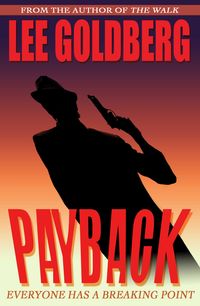
Marty McKee talks about my book .357 VIGILANTE #3: WHITE WASH (now available in a Kindle edition under the title PAYBACK) He didn't like it as much as the earlier books in the series, but still found some things to enjoy. He says, in part:
The book's highlights are its action sequences, which work very well, even though some of the villains' motivations seem weak. When Macklin is introduced in the first chapter while tinkering with his new gadget-equipped 1959 Cadillac, I turned the pages in great anticipation waiting for him to use that sucker (which he does in a bloody scene that could have come right out of an Executioner novel).
Freelancing
Screenwriter Denis McGrath talks about his experience freelancing an episode of STARGATE: UNIVERSE.
While I was off over a month trying to generate my story, fixed in stone — all the other targets were moving, and moving rapidly. Earlier scripts were going through production drafts…characters were changing and evolving. Casting, and then shooting, revealed actors' strengths that meant that they got written to more. I had only the barest, fuzziest hold on some of the secondary characters. In a new show, things change rapidly in production, and when you're in the room you absorb those changes in small increments on a daily basis.
Eventually, I begged for more scripts, and got them, and being able to digest six or seven scripts, and see the characters on the page helped me writing my drafts.
It's hard to believe that freelancing was once the rule in TV, and still is in some places. It just packs more pressure on the one or two people who have to make all the stories line up. As a freelancer, my job with my SGU script was to get it to a point where somebody else could "take it over," and see it through production. The better I did, ideally the less they'd have to rewrite.
Except of course it never works out that way, especially in a show's first season. When you're three thousand miles out of the loop of the show that's developing on those soundstages, you just do the best you can, and hope that you don't cause somebody too much work.
It's always hard freelancing an episode of a brand new series, since nobody is entirely sure what the show is or who the characters are…not the showrunners, the studio, or the network. It's trying to hit a constantly moving target. I've done it a few times… on SLIDERS, PSYCH, and on an upcoming summer series I can't talk about yet. There's no question about it…freelancing is hard, but it's not that much easier writing a script for a show that's been on the air for a season or two. Yes, everyone knows the show (including you!)… but it's harder coming up with a story or character conflict that they haven't already done or have in development.
UPDATE: Here's another view on McGrath's freelance experience from the other side of the desk as SG:U producer Joseph Mallozzi saw it.
More of Me
There's a new interview with me up on the Cinema & Fiction blog. Here's an excerpt:
Mystery, crime and detectives are a recurring element in your writing. What do you find so appealing about this type of writing?
I guess on a basic level, the great thing about mysteries is they have a lot of conflict and forward momentum. The story is driven by a need to solve the mystery — that gives you somewhere to go, a ticking clock, and built-in conflict.
You have written for TV and written novels. What do you think are some of the major possibilities and limitations of these different forms of writing?
As you say, they are very different kinds of writing. In scripts you have to show, not tell. Character and story have to be revealed only through action and dialogue. A screenplay is a blueprint, a working document for other professionals, like costume designers, location managers, and of course actors and directors. A book is very different. You can go into people's heads to tell stories and reveal character. You have to set the scene in great detail all the time. You are the director, the location manager, the actor and the director. You're creating a complete world with no limitations all by yourself. That can be exciting and daunting at the same time. I've encountered many screenwriters who simply can't write a book and many authors cannot write scripts. I've only met a few who can do both. They are different ways of telling a story and also different ways of thinking of story.
Sexually Active Senior Living
Who knew that retirement homes were a great place to pick up chicks? My Mom reveals the sordid truth in this short excerpt from her sequel-in-progress to Active Senior Living, her fictionalized memoir:
I was sitting in the lobby lounge with my buddy Larry, just passing the time of day before we went in to dinner when Dale came over and sat down on my other side and began talking to me.
"Do you like movies?" he asked.
" Yes, " I said.
Dale was all smiles. " You know, they show a movie here every night upstairs in the media room. I could come to your apartment and get you and we could go together. How about if we do that tonight?"
" No thank you," I said.
" It's an hour before dinner. Let's go to the park. I still drive and my car is out in front. Come on," he said , reaching for my arm.
I pulled my arm away and said, " No, thank you, I don't want to go to the park."
Dale leaned in closer, as if he had a secret to tell me. " Do you have a DVD player?"
" Yes, why?"
" I have a lot of movies. I could bring one to your apartment tonight. It's more fun if you watch a DVD with someone else. What time should I come over?"
" I'm not interested in watching a DVD with you," I said, leaning away from him.
" Well, then," he said, all smiles again, " Let's just go to the park together. They have benches and we could sit together and just enjoy the sunshine."
" My answer is still no," I said , hoping my tone showed that I had enough of his asking me to do something with him.
"What's your apartment number?" he asked. " I'll just come over tonight and we can visit or watch t.v. together."
"I'm not giving you my apartment number," I said , " I don't want you to come over so get that idea out of your head."
Larry who had been sitting quietly and listening to all this began to laugh. Dale looked at him, as if noticing him for the first time.
" And who are you?" Dale asked.
" I'm Larry and I don't want to watch a DVD with you, or go to a movie, or sit together to watch t.v. and don't ask me to go to the park, either."
Well, I burst out laughing at Larry's response to Dale. Dale, on the other hand, didn't find it funny and stood up, putting his hand on my shoulder. " If you change your mind and you want to get together after dinner just give me a call. I'm in apartment 104."
And with that parting request he left the lounge area.
" I think you made a conquest, " Larry said.
We were still laughing as we headed in to dinner.