Thanks to my brother Tod for this very scary video of Sarah Palin.
Current Affairs
I’m Fraking Quoted
Chris Talbott of the Associated Press picked up on my blog post a while back about the subversive power of "Frak"..and quoted me in an article on the topic that is showing up today all over the fraking place.
Lee Goldberg thinks Glen A. Larson is a genius, and not because the prolific
television writer and producer gave us "Knight Rider" and "B.J. and the Bear."
It was Larson who first used the faux curse word "frak" in
the original "Battlestar Galactica." The word was mostly overlooked back in the
'70s series but is working its way into popular vocabulary as SciFi's modern
update winds down production.
"All joking aside, say what you will about what you might
call the lowbrow nature of many of his shows, he did something truly amazing and
subversive, up there with what Steven Bochco gets credit for, with 'frak,' "
Goldberg said.
There's no question what the word stands for and it's used
gleefully, as many as 20 times in some episodes.
[…]Goldberg believes Larson should get more
credit for "frak" and has posted an appreciation on his Web site. He even sought
out Larson to let him know how he feels: "I told him, 'Frak is fraking
brilliant, Glen.' "
The reporter also talked to BATTLESTAR GALACTICA cast members, novelist Robert Crais, and he even managed (with my help) to track down Glen for a quote or two.
"Our point was to whenever possible make it a departure like
you're visiting somewhere else," Larson said. "And we did coin certain phrases
for use in expletive situations, but we tried to carry that over into a lot of
other stuff, even push brooms and the coin of the realm."
The producers of the new BATTLESTAR GALACTICA fraking love to use the word, of course.
Co-executive producer and writer Michael Angeli, an Emmy
nominee for the episode "Six of One," said using the word in scripts is
satisfying for anyone who's been censored over the years.
"It's a great way to do something naughty and get away with
it," Angeli said.
That talented motherfraker is frakin' right.
Travis McGee’s Hollywood “Wounded Birds”
Ed Gorman linked to a very interesting article about John D. MacDonald's frustration with Hollywood's attempts to bring Travis McGee to the screen.
Almost immediately after the series began, the scribe
started receiving offers to transport the McGee character from books to
television. In 1965 MacDonald had his first meeting with a quartet of
Hollywood types who wanted to buy the television rights. They were so
confident about the match between McGee and TV that they had forged on:
scripting episodes, signing contracts with sponsors, and casting Chuck
Connors in the lead role. The chaps found that "it was extraordinarily
difficult to find the right approach to a writer who doesn't believe in
television," MacDonald wrote to friend Dan Rowan. "[They were] wrong. I
believe in it. One percent of it is very very good….and 99 percent of
everything is and always has been schlock. I don't want Trav to [be
simplified as] the series tube requires, nor do I want the angle of
approach wrenched this way and that when the ratings don't move and
everybody…starts trying this and trying that."
started receiving offers to transport the McGee character from books to
television. In 1965 MacDonald had his first meeting with a quartet of
Hollywood types who wanted to buy the television rights. They were so
confident about the match between McGee and TV that they had forged on:
scripting episodes, signing contracts with sponsors, and casting Chuck
Connors in the lead role. The chaps found that "it was extraordinarily
difficult to find the right approach to a writer who doesn't believe in
television," MacDonald wrote to friend Dan Rowan. "[They were] wrong. I
believe in it. One percent of it is very very good….and 99 percent of
everything is and always has been schlock. I don't want Trav to [be
simplified as] the series tube requires, nor do I want the angle of
approach wrenched this way and that when the ratings don't move and
everybody…starts trying this and trying that."
The two filmed McGees — Rod Taylor in the movie DARKER THAN AMBER and Sam Elliot in unsold TV pilot TRAVIS McGEE (aka THE EMPTY COPPER SEA) — were underwhelming to say the least. It's no wonder that Robert Crais and Sue Grafton have refused offers from Hollywood to put Elvis Cole and Kinsey Milhone on screen…
Another Opportunity for Vanity Press Suckers To Throw Away Their Money
The Telegraph is amused by Blurbings.com, another inept "service" aimed at hopelessly stupid people who've already been suckered by a vanity press and are eager to throw away even more money:
It had to happen sooner or later: an American company
is offering writers gobbets of praise with which to decorate the covers
of their self-published books. A plug from an unknown author is
unlikely to encourage anyone to buy a book by another unknown author,
but this has not stopped www.blurbings.com offering various packages that start at $19.95 for 10 micro-bouquets.
Victoria Strauss at Writers Beware also points out the stupidity of this new attempt to shake a few more bucks from the pockets of the dumb and unwary:
According to Blurbings' About Us
page: "Normally, a blurb will cost an author and/or publisher $14 –
$23, which includes printing of the galleys, packaging and mailing
fees. The standard 30 – 50 blurbs expected per book can range from $420
to $1,150. It is also very time consuming researching and contacting
prospective authors as well as conducting follow-ups during the
duration of the process."
Uh…okay.
[…]The whole point of a blurb is that the blurber be recognizable to the
general public, or else be someone whose credentials suggest that his
or her opinion is worth taking seriously. But how likely is it that
someone like that will find his or her way to Blurbings and happen upon
your digital galley? (And if you contact them yourself, what do you
need Blurbings for?) It's far more likely that the blurbs you'll get
will come from other site users–i.e., other self- or
small-press-published authors–or, possibly, from random web surfers.
No offense to Joe Micropress Author or Jane Random Web Surfer…but
blurbwise, who cares what they think?
Emily Maroutian, one of the owners of Blurbings.com, defended her "service" in a comment on Writer Beware:
Blurbings.com was not created for big industry authors or authors, like
yourself, who don't like blurbs. Blurbings was created to help
self-published authors and small presses receive blurbs for their work.
It was created to shorten the process and make it cheaper. […]If anyone here feels as if our service is pointless then don’t use it. It’s as simple as that.
yourself, who don't like blurbs. Blurbings was created to help
self-published authors and small presses receive blurbs for their work.
It was created to shorten the process and make it cheaper. […]If anyone here feels as if our service is pointless then don’t use it. It’s as simple as that.
I don't know why the Telegraph and Victoria are criticizing Blurbings.com. Everyone knows that a ringing endorsement from a complete nobody for a total unknown is better than no blurb at all. But I think I'm going to save $20 and just ask my gardener, the cashier at Ralph's, and the first person I see on the street to blurb my next book.
The Supreme Court of Seinfeld
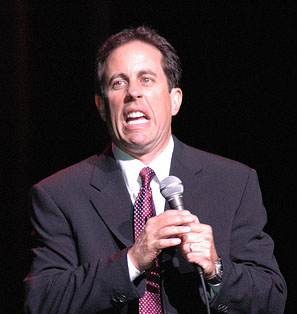
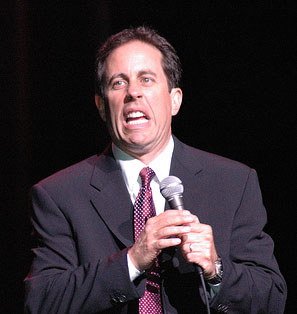
The Maryland Court of Appeals cited a SEINFELD episode to explain their reasoning in a lawsuit brought by the ex-wife of author Tom Clancy against her ex-husband for pulling out of a book deal that would have profited her. In the SEINFELD episode, Jerry tries to return a jacket because he didn't like the salesman:
The decision issued today says a trial court will have to determine whether Clancy acted in
bad faith when he withdrew from a television and paperback series that profited
the partnership he formed with his then-wife, Wanda.
bad faith when he withdrew from a television and paperback series that profited
the partnership he formed with his then-wife, Wanda.
In footnote 27, the court reprints the dialogue between Seinfeld and a store
clerk :
Clerk: I don't think you can return an item for spite.
Jerry: What do you mean?
Clerk: Well, if there was some problem with the garment. If it were
unsatisfactory in some way, then we could do it for you, but I'm afraid spite
doesn't fit into any of our conditions for a refund.
I think if Obama becomes President, he should consider putting Jerry on the Supreme Court.
(Thanks to my cousin Danny Barer for the heads-up)
Who Is The Short Bald Stranger There, Maverick is the Name…?
John McCain's claim of being "the original Maverick" prompted Chicago Sun-Times columnist Mark Brown to recall fond memories of the TV series MAVERICK…and to seek out the sage advice of my Uncle Burl Barer, the author of THE MAKING OF MAVERICK :
I mentioned to Barer how McCain was using "The Original Maverick" as
a campaign slogan, causing my initial confusion with Garner having
played, Bret, the first Maverick, which I cleared up when I remembered
his brother Bart, the other Maverick.
"Yes, you mean Jack Kelly," Barer said.
Jack Kelly?
"Jack Kelly played Bart Maverick," Barer said.
It wasn't John McCain?
"No."
Then which of the Maverick brothers did McCain play?
[…] he
patiently explained that at various times Maverick starred Garner as
Bret, Kelly as Bart, Roger Moore as Beau and Robert Colbert as Brent —
the poker-playing Maverick brothers. But never McCain.
"It wasn't, 'Who was the short bald stranger there?' " Barer said,
playing off the opening stanza from the theme song about a tall, dark
stranger.
MAVERICK was a great show back in the 1950s and holds the unusual distinction of being the only vintage TV series revived three times on three networks in three years…ABC's THE NEW MAVERICK, CBS' YOUNG MAVERICK, and NBC's BRET MAVERICK…all in the early 1980s.
How to Throw the Pitch
I'm going in to a major studio next week to pitch a TV series. In advance of the meeting, the studio wants you to send them a very short log line of the concept, sort of the equivalent of a TV Guide listing. Assuming that they like the log-line, a few days before the meeting they will send you the "Drama Series Pitch" format that they expect you to follow for your verbal presentation. Here it is:
THE TEASER—Pitch out a tease that grabs your audience, that is visual, gives a sense of the world, tone and set up of our show.
THE WORLD—After you have grabbed our listener, tell us what the world is and why you want to do a show about it.
THE CHARACTERS-Outline
our characters in order of importance, allowing what makes each one distinct to
shine through (quirks, traits, backstory). Also discuss character dynamics, how each character relates to each other and what their point of views are about each other. Tell us about triangles, rivals, love interests, etc.THE PILOT—Broad stroke the rest of the pilot. Do not go beat by beat or act by act. This should really just be broad strokes and key plot points which help establish character and set up. Also, your pilot needs to serve as an example of what a typical episode would look like (i.e. an example of a closed-ended story and examples of character conflicts).
THE SERIES—discuss what an episode of your show looks like, where you want to go in series, potential storylines and character arcs and entanglements.
THE TONE—You want to make sure you have clearly established the tone of your show and may want to hit it again in the wrap up at the end. It is often helpful to use shows that people are familiar with.
I've been in the TV business for a while, and I have done hundreds of pitches, but this is the first time anyone has ever given me a required format. I guess that the studio has been hearing a lot of meandering, unfocused, boring pitches lately.
In general, I have no problem with their format, and would certainly have included most of what they want in my pitch anyway, though perhaps not in that order.
Doing it their way is fine for me and has actually helped us focus our pitch and tighten it up. But I think there are some cases where rigid adherence to their format could kill a pitch. Not all series ideas are best told with a teaser and the pilot story…nor do all ideas lend themselves to comparisons to previous series ("It's HANNAH MONTANA meets THE SHIELD with a touch of BATTLESTAR GALACTICA").
Also some writers just have a natural, entertaining way of pitching that suits their personality and thinking that might not follow a template…but still gets the key points across that the studio is looking or. Asking those writers to adjust to a particular template might throw them off and undermine what otherwise would have been a great pitch.
Maybe the third time will be the charm…or, rather, CHARMED
Variety reports that ABC has ordered a pilot based on the 1987 movie THE WITCHES OF EASTWICK which, in turn, was an adaptation of the book by John Updike. This will be the third time a network has tried to turn the Jack Nicholson-Cher-Susan Sarandon-Michelle Pfeiffer movie into a weekly series.
In 1992, scribes Carlton Cuse and Jeffrey Boam were behind a "Witches of Eastwick" pilot for NBC. That version starred Catherine Mary Stewart, Julia Campbell, Ally Walker and Michael Siberri.
Fox developed a different version in 2002. The abbreviated-titled "Eastwick," from exec producer Jim Leonard and scribes Jon Cowan and Robert Rovner, focused on the teenage sons of the original witches. Lori Loughlin, Marcia Cross and Kelly Rutherford starred.
The pilot is being written by Maggie Friedman, who has some bewitching experience — she penned an unsold pilot about about a witch-turned-life coach for the CW last season.
The “Affaire” of Unethical Conduct in our “Romantic Times”


I’ve been engaged in a discussion on the Writer Beware blog about the egregious ethical lapses committed by Affaire de Coeur magazine in their editorial coverage (running cover stories and reviews about books published by their advertising director, requiring some publishers and authors to buy advertising in exchange for reviews, etc.).  I thought it might be helpful to share the portion of the Society of Professional Journalists’ Code of Ethics that applies to the relationship between editorial and advertising content:
Journalists should be free of obligation to any interest other than the public’s right to know. Journalists should:
— Avoid conflicts of interest, real or perceived.
— Remain free of associations and activities that may compromise integrity
or damage credibility.
— Refuse gifts, favors, fees, free travel and special treatment, and shun secondary employment, political involvement, public office and service in community organizations if they compromise journalistic integrity.
— Disclose unavoidable conflicts.
— Be vigilant and courageous about holding those with power accountable.
— Deny favored treatment to advertisers and special interests and resist their pressure to influence news coverage.
— Be wary of sources offering information for favors or money; avoid bidding for news.The SPJ Code of Ethics is voluntarily embraced
by thousands of writers, editors and other news professionals. The present version of the code was adopted by the 1996 SPJ National Convention, after months of study and debate among the Society’s members.
Sigma Delta Chi’s first Code of Ethics was borrowed from the American Society of Newspaper Editors in 1926. In 1973, Sigma Delta Chi wrote its own code, which was revised in 1984, 1987 and 1996.
Most newspapers and magazines have adopted similar guidelines. For example, here are the guidelines for publications produced by the Mystery Writers of America (I should disclose that I was on the committee that drafted these guidelines):
For Articles, columns, interviews and essays:
-
–
The editor should maintain honesty, integrity,
accuracy thoroughness and fairness in reporting and editing of articles,
headlines and graphics.
-
–
There should be a clear distinction between
news/feature stories and opinion pieces. It
should be made clear that any opinions expressed are those of the author
and do not necessarily reflect the views of the Mystery Writers of America or the
local chapter.
-
–
The reporter or author of editorial content in
the newsletter must avoid any conflicts of interest, real or perceived, with
regard to the subject of his articles. All potential conflicts should be
disclosed (eg: an author interviewing his own publisher or editor).
-
–
The reporter or author of editorial content in
the newsletter should refuse gifts, favors, fees, free travel and special
treatment related to the articles they are writing (eg: free travel and
registration at a conference in return for the article).
-
–
Unless a piece is clearly identified as “opinion,”
personal views such as religious beliefs or political ideology should be kept separate
from the subjects being covered. Articles should not be approached with overt
or hidden agendas (eg: someone who hates cozies shouldn’t be writing about the
popularity of cozy mysteries).
-
–
Competing points of view should be balanced and
fairly characterized.
-
–
Persons who are the subject of adverse news stories or features should be allowed a
reasonable opportunity to respond to the adverse information before the story
is published.
-
–
Fairness means that all important views on a
subject are presented and treated even-handedly.
-
–
Authors should always cite their sources and
never plagiarize.
For Advertising:
-
–
Editorial impartiality and integrity should
never be compromised by the relationship and the chapter should retain
editorial control of ALL content. Selection of editorial topics, treatment of
issues, interpretation and other editorial decisions must NOT be determined by
advertisers.
-
–
Editors must never permit advertisers to review
articles prior to publication.
-
–
Advertisers and potential advertisers must never receive favorable editorial
treatment because of their economic value to the newsletter.
-
–
Editors must have the right to review, prior to
publication, all sponsored content and other advertiser supplied material.
-
–
The choice of advertisers (conferences,
self-publishers, editorial services, etc.) should not bring the MWA into
disrepute or imply an endorsement by our
organization of any of the goods or services being advertised. This is
especially important when it comes to self-publishing firms, agency representation,
editorial services, writing contests, and writers conferences.
-
–
There should be a clear and unequivocal separation
between the advertising and editorial content of the newsletter. Editors have
an obligation to readers to make clear which content has been paid for, which
is sponsored, and which is independent editorial material.
For “Non-Paid” Promotion
-
–
Editors should carefully review all “non-paid”
promotional content, such as lists of
upcoming events and contests, to assure the events and organizers are reputable
and legitimate. The printing of these announcements in our newsletter can imply
to some readers an endorsement by the MWA.
-
–
Occasionally, some newsletters post news about
publishers accepting submissions. Editors
should review the MWA’s List of Approved Publishers before printing material of
this nature.
I find it disgraceful that Affaire de Coeur and the Romantic Times require some publishers and authors to buy advertisements in exchange for having their books reviewed. Not only is it unethical conduct, it’s also unfair to small presses & authors … and brings into serious doubt the editorial credibility of both magazines.
Affaire de Coeur doesn’t just sell their reviews to advertisers, they also sell other kinds of coverage. Here’s an excerpt from the Affaire De Coeur website page that explains their various advertising packages:
“To compliment your ad and review we also offer interviews or articles. If you would like an interview let us know 3 months in advance so it will go in the same issue as your review and ad. We accept articles at any time, we need articles 3 months in advance. All articles must receive approval on subject matter.”
“We will not accept submissions less than three months prior to the date of publication unless it is associated with an ad. We do not review books after publication unless it is done in association with an ad”
If you buy an advertisement with Affaire de Coeur, they will “compliment” it with articles and reviews. They will gladly review your book after publication, or if you submit it late, if you buy an ad. There’s clearly a connection between buying ads and getting coverage. They aren’t even subtle about it.
But do they inform their readers which reviews, articles and interviews were published because of their connection with advertising? Of course not.
Basic ethical conduct requires that any review or article that is printed in exchange for advertising should be labeled as such so the reader knows just how “objective” the coverage really is (just how “honest” can a review be if it’s paid for?)
And if a reporter or editor has a financial stake in the books or companies being written about or reviewed, that should also be clearly disclosed, because it’s a conflict-of-interest and has an obvious impact on the “objectivity” of the reporting and placement of the stories.
But those disclosures aren’t being made to the readers of Affaire de Coeur or Romantic Times. If I was a reader or writer of romance fiction, I would be outraged about the conduct of these two magazines. That is why I have refused to acknowledge Affaire de Coeur’s “five star review” of my book.
UPDATE: I just stumbled on a November 2007 blog post on EREC that shows just how much coverage in Affaire de Coeur that Light Sword received in one issue compared to other small press advertisers — which is no surprise, since Light Sword’s co-owner is the magazine’s advertising director:
Light Sword Publishing
* 3 pages of advertising
*
6.5 pages of content (3 being an article that is clearly
self-promotional, aimed at authors not readers and available for free on their website)
* 1.5 pages of book review spaceMedallion Press
* 2.5 pages of advertising
* 2.5 pages of book review spaceParker
* 0.25 pages of advertising
* 0.75 pages of book review spaceDafina
* 0.25 pages of advertising
* 0.75 pages of book review spaceTorquere Press
* 1 page of advertising.My point? I’m not sure. Perhaps that advertisers should buy ad space.
Readers should ‘buy’ the other content by having it aimed squarely at
their interests. 26 pages of large press book reviews, fine. 10 pages
puffing the advertisers wares… not so fine. If you buy ads you can
apparently also write the magazine’s content
and get your small press books reviewed. So if you want only large
press book reviews at least half the magazine will be of interest to
you. The rest seems to be almost entirely at the pleasure of the
advertisers.
When a Wanna-Be Publisher Becomes a Scammer
Scam-busting author Victoria Strauss’ post on Writer Beware about the fraud judgments levied against Linda Daly’s Light Sword Publishing has provoked an interesting debate on her blog. Along the way, Strauss has made some important distinctions between a genuine “small press” and a pseudo-publisher:
There are many
excellent small presses, which function entirely professionally and are
taken seriously by readers, writers, and publishing professionals.
Reputable small presses have always been an honorable alternative to
large commercial houses, and there are more of them now than ever.
These professional small presses, however, are NOT equivalent to the
Light Swords of the world, which are run like pocket dictatorships by
people who know absolutely nothing about editing, publishing, or book marketing–never mind running a business–and aren’t interested in learning.
I want to take that a step further (as I did on her blog). I’m on the Mystery Writers of America’s membership committee, which reviews applications from publishers
who want to be on our Approved Publishers list. In that capacity, I’ve encountered an astonishing number of
so-called “small publishers” who turned out to be nothing more than aspiring writers who bought some ISBN numbers and opened an account with a
POD company.
These pseudo-publisher are a mix of true scammers (like PublishAmerica, Airleaf, etc.) and people who
set out to do no harm but simply have no clue what being an “editor”
and a “publisher” really involves.
To me, an inexperienced
“publisher” becomes a scammer when they start touting marketing,
editorial and publishing experience they don’t actually have, when they
make promises they know they can’t keep, and when they begin charging
authors to get into print (another sign is when a court declares them
guilty of defrauding authors, as is the case with Light Sword).
The authors are inevitably tainted by their association with a scammer or an inept wanna-be publisher. As Victoria says:
This is not to say that good books can’t be published by amateur
micropresses. […] The enormous number of unpublishable books
with which society has been lumbered as a result of the proliferation
of micropresses–not to mention the POD self-publishing services–is an
annoyance and a nuisance, but the real tragedy of all these faux
publishing options, in my opinion, is that they can entrap writers
whose books deserved better.
That
said, the aspiring writers entrap themselves with their desperation, impatience, gullibility, and their
laziness.
The majority of writers who have been scammed by PublishAmerica,
Authorhouse, Airleaf, Tate, Quiet Storm, Light Sword and countless other vanity
presses and pseudo-publishers could have easily avoided their fate by
using common sense, doing a tiny bit of research, and asking some basic
questions about the professional qualifications and experience of the
people they were getting into business with BEFORE signing a contract. Others were simply looking for a short cut and discovered the hard way that there aren’t any. But I think Victoria said it best:
There are any number of reasons why writers ignore clear warning
signals, including the frustration of a long and unfruitful publication
search. Other writers, of course, don’t take the time to learn about
the field they’re trying to break into, and don’t know what the warning
signs are. But whatever the reasons writers fall victim to schemes and
scams and amateurs–and with every effort to maintain respect and
compassion for those victims–writers need to understand that THEY
ARE RESPONSIBLE for educating themselves, for researching their
options, and for making informed (as opposed to wishful or ego-driven)
decisions.We don’t help them by pretending that this isn’t so.
UPDATE: Blogger Michele Lee makes a strong case (with great links) that it’s time that authors took more responsibility for their poor choices:
The blame lies with both parties of course. Much of the behavior of
scammers and crappy publishers is reprehensible and inexcusable. But
there is so much information available to writers these days. We don’t
live in the world of ten years ago. There are so many places to research agencies and publishers these days (and for free!). I simply do not understand. There’s no excuse anymore, other than sheer newness, not to be a well researched. I suspect the professional publishing world is starting to view
things this way as well and the tolerance for lazy writers is severely
plummeting.