Variety reports that Marc Forster, director of MONSTER’S BALL and FINDING NEVERLAND, has been hired to helm the next James Bond film, which will star Daniel Craig. This is an unusually edgy choice for the legendarily conservative Bond producers and shows how dedicated they are to continue redefining 007 for a new generation (these are the same producers who stuck with director John Glenn for several Bond films and turned away overtures from the likes of Quentin Tarantino and Steven Spielberg). CASINO ROYALE scriptors Paul Haggis, Neil Purvis & Robert Wade are once again teaming up on the script. Purvis & Wade are Bond veterans… they also wrote the last few Pierce Brosnan 007 films.
Current Affairs
The Verdict is In
Variety reports today that the jury has delivered their verdict in the Clive Cussler SAHARA case. They’ve awarded the author $5 million in damages and ruled that the producers have to pay him $8.5 million for the rights to the second book that they’d originally licensed to film…but that now won’t ever be shot. The jury decided that Cussler is owed the film rights back because, under the terms of his contract, principal
photography on SAHARA did not start on time.
On the other hand, the jury also determined that Cussler falsely and intentionally miss-represented the sales figures of his books, which means the Judge could throw out the jury’s award for the additional fee for the second book. The Judge will schedule a hearing to deal with that issue.
Naturally, both sides are claiming victory.
"We’re $3.5 million ahead and Clive got his rights back," said
veteran showbiz litigator Bert Fields, who represented Cussler. Fields
added that because of the jury’s finding that Cussler intentionally
misrepresented book sales, he would not rule out an appeal.Putnam
maintained that Crusader was vindicated because of the findings of
Cussler’s intentional misconduct and the fact that the only damages
definitely awarded at this point were the $5 million to Crusader."We
consider it a great victory," Putnam said. He added that the disparity
between the findings of misrepresentation and the damages would make
him consider an appeal, particularly if the court finds Cussler is owed
for the second book.Cussler, 75, said he was pleased with the verdict but wasn’t ready to gamble again on turning one of his many books into a film.
"There won’t be another Clive Cussler film, at least not during my lifetime," he said.
I Can Finally Stop Running from Police For a Crime I didn’t Commit…
From the Times-Herald Record in Middletown, NY…
Man surrenders in break-ins, copper pipe thefts
Over the winter, Lee Goldberg, 24, broke into 23 bungalows at the former Lake House Hotel on Lake House Road in Woodridge, said Fallsburg police.
Cops say Goldberg ripped out copper piping from each on the bungalows, doing between $80,000 and $100,000 in damage. They say he got between 300 and 400 pounds of pipe, which he sold at Weinert Recycling in Liberty for a total of about $2,000.
Police say Goldberg also broke into another colony nearby, taking about 50 pounds of copper pipe, which he also sold.
Police said they’ve been looking for Goldberg for a while, and on Tuesday he turned himself in at the Fallsburg police station.
He was charged with 24 counts of third-degree burglary and single counts of third-degree grand larceny and second-degree criminal mischief, felonies. He was also charged with 23 counts of petty larceny, a misdemeanor. Goldberg was arraigned and sent to Sullivan County Jail without bail, pending an appearance in Fallsburg Town Court.
Police said more arrests are expected.
It’s going to be nice not to have to live in fear any longer.
I’ve Sold 150 Million Copies of My Books

 Okay, maybe I haven’t. But according to Clive Cussler, the number doesn’t matter anyway.
Cussler is on the witness stand here in L.A. in a clash of lawsuits over the failure of the movie SAHARA, based on one of his Dirk Pitt novels. He claims the movie-makers breached a contract that gave him total control over the script. Based on accounts I’ve read of the producer’s testimony, it seems to me that he’s right.
The producers claim he fraudulently inflated the number of books he sold to get more money out of them for the movie rights. Based on Cussler’s testimony, reported today in the L.A. Times, it seems to me that they are probably right, too.
On Friday, Cussler offered myriad explanations for his accounting of the "Sahara" numbers. Asked if he pulled the numbers out of thin air, Cussler said, "Pretty much." He added: "I honestly thought I probably did sell 100 million books. That doesn’t seem out of the ordinary to me."
[…]Cussler previously testified in a deposition that his agent admonished him in the late 1990s never to say how many books he sold because the amount was not known. Instead, Cussler said, he was advised to use the phrase "books in print."
Asked why he continued to use the 100 million estimate anyway, Cussler testified on Friday, "I slipped up…. I forgot."
[…]In June 1999, Cussler described his frustration with the entertainment industry in a handwritten letter. "Over a hundred million books sold worldwide now, and still Hollywood doesn’t get it," he wrote.
In August 2000, Cussler’s website stated that he had sold more than 100 million books. The number was updated to 125 million in April 2003. That same month, Cussler said on a "Sahara" promotional video, "They tell me now they’ve sold over 130 million."
The remark "meant nothing," Cussler testified Friday.
The actual sales of his books from 1973-2000, according to an audit by a forensic accountant, is about 42 million copes. I don’t know about you, but I think that’s a pretty impressive number of books. You’d think Cussler would have been happy trumping that figure…without having to inflate it to 130 million. Then again, according to Cussler, it means nothing. If that’s so, why does he keep jacking up the number?
The reporting on the trial over the last few weeks has been fascinating and informative reading. We’re learning just how much people unapologetically and blatantly lie to each other in the movie business (as if we didn’t know already). We were also treated to a line-by-line dissection of the movie’s budget, right down to how much was spent on bribes.
As far as I’m concerned, both parties are at fault here. The only winners are the public, who are being treated to a trial that’s a lot more entertaining than SAHARA was.
National Treasure

 Mark Evanier reports that the Mann National in Westwood is closing. I remember how wowed I was by that theater when I first came to Los Angeles in 1980 to go to school at UCLA. To me, the Mann National epitomized everything that was Hollywood. It was huge (this was the era before stadium seating), it was plush, it was gaudy, and it was glitzy. Every time a big movie opened at the theater, they’d paint a three-story reproduction of the one-sheet on the side of the building. And it wasn’t uncommon to bump into stars like Neil Simon, Dustin Hoffman, and Sean Connery at the popcorn counter. I once nearly collided with Woody Allen on my way out of theater…because I was busy staring up at one of those big movie poster paintings. I saw hundreds of movies at that theater while I was in college…and every time I’ve driven past the building since, I’ve thought about those movie poster reproductions. I’m sorry to see the theater go…but given the value of real estate these days, I’m not surprised.
What If JFK Lived?
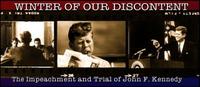
 My friend Bryce Zabel has launched a new blog that features the first three chapters of "alternative history" novel he’s co-written with Harry Turtledove that asks this question: What if JFK survived the assassination attempt?
Am I Satan…
…or just a sad little man with serious self-esteem issues who longs to write fanfiction? You tell me. I am too distracted to decide…I’m very busy working on my FARSCAPE/BATTLESTAR/HARRY POTTER crossover slash epic.
Call’em as you See’em
Karen Scott talks on her blog about how much she likes sex scenes that tell it like it is:
I love good sex scenes in my books. I love books that call a cock, a cock, and a pussy, a pussy…
That’s certainly what I try to do in all my DIAGNOSIS MURDER books. Karen believes that sex scenes are required in a good romance novel.
If the love scenes are well written, then I’m likely to buy, if not, I’ll
probably leave it on the shelf. Does that confirm every stereo-type out there
about romance readers? Probably, but I’m not here to promote respect for the
genre, so I couldn’t really care less.[…]It
bemuses me to think that there are hundreds of thousands of romance readers out
there who pretend that sex in books don’t matter to them, when in reality, it’s
probably what they’re secretly looking for.
Secretly? All you have to do is look at the covers to know what the books are selling and what the readers are buying.
As The Crow Flies
 My friend Bryce Zabel talks about the development of his TV series version of THE CROW, which is about to be released on DVD. It’s fascinating stuff (what’s even more fascinating is that he saved his business card):
What do you do when the incredibly violent film you are asked to adapt to a TV audience is based on cruelty, and the main character is driven by a thirst for revenge?
My answer? You expand the premise to fully explore the nature of life after death, and you change the character quest from revenge to redemption.
And how do you handle the fact that the cult film was made infamous by the horrible on-set death of its star, Brandon Lee?
That was a tougher question because the idea behind the TV series was to use the Eric Draven character, the one who’d been in the comics and that Brandon Lee had played. My take was that, tragic as Lee’s death was, George Reeves’ tragic death did not prevent Christopher Reeve or Dean Cain from playing Superman, and that we would just have to proceed and hope that our own version stood intact on its own.
Good Advice, Faulty Logic
Lynne W. Scanlon, the self-proclaimed Publishing Contrarian, urges aspiring authors to get someone to read their manuscripts and offer an honest opinion. That’s very good advice and I’m all for that. I’d even urge authors to join a local writer’s group or take some classes through their university extension program.
But then Scanlon suggests that it’s okay to pay a literary agent or editor to read your book. She uses some awfully faulty logic to back-up her argument.
Everywhere you turn on the Internet publishing pundits scream: NEVER pay a literary agent at a literary agency or an editor at a publishing house to read your manuscript. If they ask for money upfront, they are thieves! You do realize that it is routine for in-house editors to farm out manuscripts to freelance editors to evaluate or edit. You do know that Publishers Weekly pays a stable of reviewers to cough up 250-word reviews routinely, and, in fact, has commissioned reviews for over 100,000 books since 1987. (The Wicked Witch does her homework…sometimes.)
It’s one thing for a publisher or a magazine to hire freelancers to read manuscripts…it’s an entirely different thing to ask an aspiring author to pay to have their work submitted and considered. Legitimate agents make their money from commissions…that’s their incentive for selling your book…NOT from reading fees. Legitimate publishers make their money by publishing, distributing and selling your book….NOT by charging authors for editorial services. And legitimate publishing industry magazines make their money off subscriptions, newsstand sales and advertising…NOT by charging authors to review their books.
So let me underscore the very good advice that she mocks:
NEVER pay a literary agent at a literary agency or an editor at a publishing house to read your manuscript. If they ask for money upfront, they are thieves!
Do I think it’s wrong to ever pay someone to read your manuscript? No, of course not. It’s only wrong if it’s a literary agent or publisher asking you for it.
There are lots of freelance editors, some with very impressive credentials, offering to criticize manuscripts. Whether or not you should hire one depends on lots of things. Are you having difficulty getting the manuscript the way you want it? Is it consistently getting rejections from publishers? etc.
If you decide to pay someone to read your book, do your homework first. Does the editor have real experience? Is he any more knowledgeable than your gardener or your Aunt Betty? Is the fee they are asking reasonable? What specific services will you be getting for the money? Be sure to ask for a list of their previous clients and give them a call. Were they happy with the advice they got? Did their books get published?
Some of those freelance editors have been very helpful to authors. But I know an author who spent thousands of dollars to have a very well-known, former editor read his book…and all he got for his money was his typos & miss-spellings corrected. Buyer beware.
In my opinion, you are much, much better off spending the money on a creative writing course, where you will benefit from the teacher, the students, and the experience of reading and critiquing the other students’ work. You will also have a real motivation to churn out pages every week. Not only will you be getting honest feedback…you will also be learning new skills. It’s money well spent (assuming the teacher is good, of course).
You can even go the "free" route and join a writers group. There’s bound to be one at your local Barnes & Noble. I know several authors and screenwriters who have been part of groups like this and have gone on to great success (Edgar winner Theresa Schwegel comes to mind).
Scanlon goes on to suggest that you could offer a professional book critic a couple of hundred dollars to give your manuscript a thorough read and write an honest, unflinching 500-700 word review for you. This wouldn’t be a review for publication…it would be a reality check. Is your book any good? If not, why? She writes:
I made a few phone calls and fired off a few emails to very qualified publishing and writing professionals, including Frank Wilson, blogger and book critic for the Philadelphia Inquirer, who described book reviewers as a “dying breed” because of disappearing outlets in which to ply their trade. He and other reviewers confirmed that if you offer a reviewer $300, in all likelihood that reviewer will jump through a hoop of fire to get the job.
I asked a few critics I know how they’d feel about an offer like that and the response was mixed. A few would consider it, others were offended by the suggestion. No one that I contacted was willing to "jump through a hoop of fire" to do it. And it could pose ethical problems for the critic with some publications and, perhaps, later if the manuscript is published and the book assigned to them for review.
Even so, it’s a very interesting idea and is an option worth considering for aspiring authors. But, again, do you homework. Read the critic’s work AND the books he’s reviewed. Do you agree with his opinions? Is the critic knowledgeable and respected? Does he have a thorough understanding of structure, character and dialogue as well as the requirements of your particular genre?