The Clock is Ticking and the Hands Are Dripping Blood

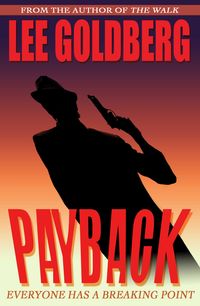
Vigilante 3  Marty McKee talks about my book .357 VIGILANTE #3: WHITE WASH (now available in a Kindle edition under the title PAYBACK) He didn't like it as much as the earlier books in the series, but still found some things to enjoy. He says, in part: 

The book's highlights are its action sequences, which work very well, even though some of the villains' motivations seem weak. When Macklin is introduced in the first chapter while tinkering with his new gadget-equipped 1959 Cadillac, I turned the pages in great anticipation waiting for him to use that sucker (which he does in a bloody scene that could have come right out of an Executioner novel).

Mansfield, Here I Come

Mansfield  As you read this, I am on my way to Mansfield University in Pennsylvania, where I will be speaking, teaching and signing over the next few days. This came about through a program at the Academy of Television Arts & Sciences, which sends industry professionals to schools all across the country to share what they know about the TV biz with the next generation of writers, producers, and directors. I'm really looking forward to meeting the students, the professors, and the community…and I shall report back to you on my experience there.

You Can Become a Kindle Millionaire, Part 17: The Bet

The following is an email exchange between me and Joe Konrath earlier this month:

TO: LEE GOLDBERG

FROM: JOE KONRATH

If I were you, I'd rename all the .357 Vigilante books getting rid of ".357" and "Vigilante" in their titles. The new covers should be generic–maybe a gun or some sort of weapon as the central image–but they should also tie together as a brand. And they should be done by an artist. Maybe a friend (you must have graphic artist friends) or maybe you can hold a contest on your blog. I'm convinced your covers and titles (which scream "Men's Action") are holding back sales of this fun series. 

TO: JOE KONRATH

FROM: LEE GOLDBERG

I'm not sure that changing the covers for .357 VIGILANTE (or the titles) will help. The books are what they are — pulpy, mens action adventure novels from the 1980s. That is their appeal…and their drawback. 

TO: LEE GOLDBERG

FROM: JOE KONRATH

Give me $XYZ. I'll give it to my graphic artist to redo the covers for the Vigilante books. Let me retitle them and do the product descriptions, and I bet your sales go up at least 25% in a two month period (compared to your last two months of sales.) If they don't, I'll give you the $XYZ back, and you get the covers for free. That's how sure I am those books will sell with the right packaging.

TO: JOE KONRATH

FROM: LEE GOLDBERG

You have a deal!

So I sat back and let Joe have his way with my books. Here's the original cover for .357 VIGILANTE:
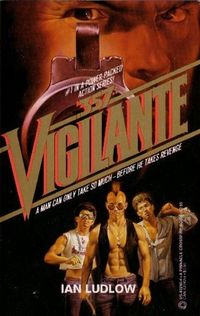
Vigilante1forsmashwords
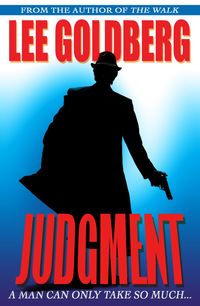
And here is what he did with it:

Vigilante 1
Here is the original cover for .357 VIGILANTE #2: MAKE THEM PAY:
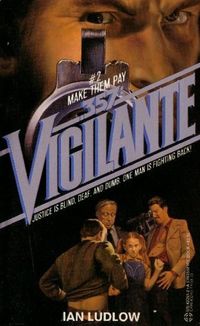
Vigilante2forsmashwords
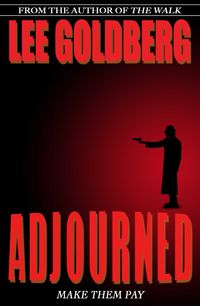
And here is what he did with it:

Vigilante 2
Here's the original cover I cobbled together for .357 VIGILANTE: DIE MR. JURY, an omnibus collection of all four .357 VIGILANTE books:
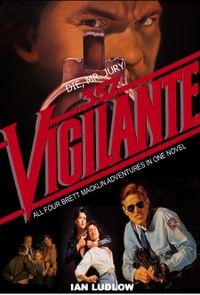
Face and logo9
Here's the revamp I did for it last month:

Die Mr Jury1l
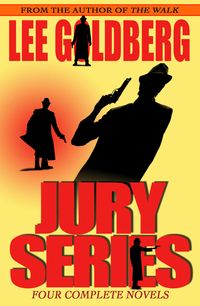
And here's what Joe did:

Jury Series
It's only a little past mid-month, but already it's clear that he's won the bet and his repackaging is a success.

Last month, 357 VIGILANTE  sold 59 copies or about 2 copies a day. This month, with the new title and cover, it has already sold 46 copies, or about 3 copies a day. It remains to be seen whether that pace of sales will continue for the rest of the month. But wait…

 .357 VIGILANTE #2: MAKE THEM PAY sold 39 copies last month and now, with the new title and cover, it has already topped that by selling 43 copies. But wait…

.357 VIGILANTE #3: WHITE WASH sold 23 copies last month. So far this month, with the new title and cover, it has sold 27 copies.  But wait…

.357 VIGILANTE #4: KILLSTORM sold 14 copies last month. But with the new title and cover, it has sold 48 copies. That's right, the sales have more than tripled and the month isn't over yet. But wait, it gets even better

.357 VIGILANTE: DIE MR. JURY sold 20 copies last month and now, with the new title and cover, it has sold 47 copies…the sales have more than doubled and the month isn't over yet. What's really surprising about this bump is that the book is priced at $4.99, making it the most expensive of my previously published/out-of-print titles on the Kindle. They aren't buying it because it's cheaper than everything else out there…I believe they are doing it because they think they are getting a great deal, four books for the price of one, a point Joe hammered home on the new cover far more effectively (and clearly) than I did on the old ones.

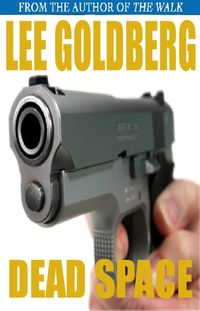
Based on these results, I quickly reworked the covers of MY GUN HAS BULLETS, THREE WAYS TO DIE and BEYOND THE BEYOND (retitling it DEAD SPACE) to take advantage of what I learned from the bet and from Joe's example.

What did I learn?

1. Your covers should have a clear, simple, striking image that will still pop out when the cover is reduced to the size of a postage stamp.

2. Your covers need to have a consistent, branded look.

3. Don't be afraid to experiment, to rethink everything about how your book is presented: the title, the cover art, the categories its listed under, the way you describe it, the way you've priced it. Just because your book has been posted, that doesn't mean it's been carved in stone and can't be altered. You need to adapt to find your audience. In other words, you can't just post your book on the Kindle and leave it. Your book will continue to need attention and, if necessary, updating to stoke sales.


Thanks for the Memories

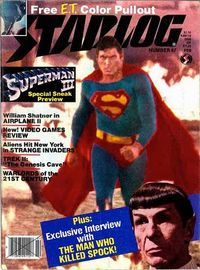
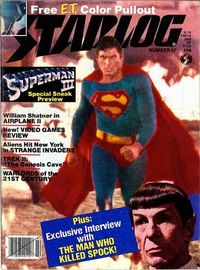
Starlog67cover  I put myself through UCLA writing for the The Daily Bruin (along with future X-FILES producer Frank Spotnitz) and freelancing for local and national publications. I also ended up writing a few sleazy novels under the pen name "Ian Ludlow," but that's another story.

What got me thinking back to those days was a blog post by John Zipperer , reviewing the February 1983 issue of Starlog, which was a milestone for me because it included my interview with Star Trek II screenwriter Jack Sowards — and my first sale to Starlog Magazine. I would end up writing hundreds of articles for Starlog (maybe it was less, but it sure felt like hundreds!) over the years that followed, but I can still remember how thrilling it was for me to get that acceptance letter from Dave McDonnell who, as it happened, was just starting what would be end up being a nearly thirty year career as managing editor of the magazine. 

It wasn't just a way to put myself through school…it was my real education. What I learned from all the screenwriters, directors,  network executives, producers, studio heads and actors that I interviewed for Starlog, Newsweek, American Film, Los Angeles Times, San Francisco Chronicle, and other publications shaped the career I have today. They taught me what I know. 

I am still amazed at all the people I got interview…like George Lucas, William Friedkin, Richard Donner, Lorenzo Semple Jr., Robert Zemeckis, Richard Maibaum, Wes Craven, Peter Hyams, Stephen J. Cannell, Steven Bochco, Richard Marquand, Glen Larson, Tom Cruise, Roger Moore, Roy Huggins, Johnny Depp, Fred Silverman, John Lithgow, Brandon Tartikoff, Grant Tinker, Bud Grant, Norman Lear, Martin Landau, Gene Roddenberry, Kurt Russell, John Korty, Paul Verhoeven, Harlan Ellison, Irvin Kershner, Dan Curtis, Wolfgang Petersen, William Shatner, Timothy Hutton, Roy Scheider, Michael J. Fox, Roger Corman, Ray Bradbury, Darren McGavin, Chevy Chase, John Carpenter, W.D. Richter, Raquel Welch, to name just a few (some of whom, like Cannell, Silverman, Huggins, Larson, Corman, Hutton and Scheider, I would later end up working with as a writer/producer. Only two of them, Cannell and Huggins, remembered that we'd met years before when I was a reporter, but that's because I interviewed them multiple times). 

And I knew how lucky I was even as it was happening. I still have many of audio cassettes from those interviews. One of these days I should get around to digitizing them before they erode away forever…

More of Me

There's a new interview with me up on the Cinema & Fiction blog. Here's an excerpt:

Mystery, crime and detectives are a recurring element in your writing. What do you find so appealing about this type of writing?

I guess on a basic level, the great thing about mysteries is they have a lot of conflict and forward momentum. The story is driven by a need to solve the mystery — that gives you somewhere to go, a ticking clock, and built-in conflict. 

You have written for TV and written novels. What do you think are some of the major possibilities and limitations of these different forms of writing?

As you say, they are very different kinds of writing. In scripts you have to show, not tell. Character and story have to be revealed only through action and dialogue. A screenplay is a blueprint, a working document for other professionals, like costume designers, location managers, and of course actors and directors. A book is very different. You can go into people's heads to tell stories and reveal character. You have to set the scene in great detail all the time. You are the director, the location manager, the actor and the director. You're creating a complete world with no limitations all by yourself. That can be exciting and daunting at the same time. I've encountered many screenwriters who simply can't write a book and many authors cannot write scripts. I've only met a few who can do both. They are different ways of telling a story and also different ways of thinking of story. 

Me Down Under

Elizabeth Farrelly of the Sydney Daily Herald is a frustrated Kindler. Whenever she goes searching for books, she gets sent to people like me…and my Mom.

You can't search alphabetically, and much as Amazon vaunts its relationship with publishers you can't get Pete Dexter or Tim Winton or A.A. Gill and if you search Carl Hiaasen you get three Lee Goldberg westerns and a self-helper called Active Senior Living.

I don't think I've written any westerns (besides bits of MR. MONK IN TROUBLE), but it's still nice that she remember me in the midst of her Kindle woes.

The Mail I Get

I need your invaluable expert advice. I'm going to pitch to a network in several weeks. It's my first time doing this so while I have the treatment ready, how would I present and package the actual treatment in terms of putting each copy in binders, have covers on each copy, etc. Thanks Lee.

I never do anything fancy. I just print out the pitch, black-and-white, no fancy graphics or fonts, with a cover page that has the title and byline centered, and the date and my contact info (or agent, or studio, depending on the auspices the meeting was arranged under) in the lower right. I staple the upper, left hand corner of the document and turn it in.

The Mail I Get

I recently got an email from a debut author looking for some touring advice. She wrote, in part:

My debut novel is coming out in May, and I'll be spending all of June traveling around the country, visiting bookstores and book clubs. My schedule is anchored by reading/signing events at key bookstores, with private parties and book club meetings in the local areas around them. As I finalize my schedule, I notice I have a lot of downtime on weekday daytimes. Obviously, most people are at work then, so there's not much to do […] Besides bookstore drop-ins, what are ways for a traveling writer to make productive professional use of those weekday daytimes?

Write. Or relax. If you haven't done a book tour before, you will find that it is exhausting. If you want to be at your best for those evening signings, talks, etc., you need some down time. I also find that writing keeps me mentally "centered" when I'm traveling, especially if I'm hitting several cities over a very few days. It can become a blur. It's also nice to do a little sight-seeing…it might spark ideas or scenes in your next book.

But if you are intent on maximizing your promotion time, try to call ahead to each city and arrange a lunch or breakfast with a newspaper reporter or local blogger. Or try to arrange a radio or tv interview with a local station. If all else fails, you can help spread good will (and positive word of mouth) by offering to talk to a local high school or college English class…or at a local library.