Publishers Screwing Authors out of E-Book Royalties

Here's an Authors Guild report regarding how publishers are ripping off writers on ebook royalties…

E-Book Royalty Math: The Big Tilt
 
To mark the one-year anniversary of the Great Blackout, Amazon's weeklong shut down of e-commerce for nearly all of Macmillan's titles, we’re sending out a series of alerts this week and next on the state of e-books, authorship, and publishing. The first installment (“How Apple Saved Barnes & Noble. Probably.”) discussed the outcome, one year later, of that battle. Today, we look at the e-royalty debate, which has been simmering for a while, but is likely to soon heat up as the e-book market grows. 
 
E-book royalty rates for major trade publishers have coalesced, for the moment, at 25% of the publisher’s receipts. As we’ve pointed out previously, this is contrary to longstanding tradition in trade book publishing, in which authors and publishers effectively split the net proceeds of book sales (that's how the industry arrived at the standard hardcover royalty rate of 15% of  list price). Among the ills of this radical pay cut is the distorting effect it has on publishers’ incentives: publishers generally do significantly better on e-book sales than they do on hardcover sales. Authors, on the other hand, always do worse.
 
How much better for the publisher and how much worse for the author? Here are examples of author’s royalties compared to publisher’s gross profit (income per copy minus expenses per copy), calculated using industry-standard contract terms:  
 
“The Help,” by Kathryn Stockett  
Author’s Standard Royalty: $3.75 hardcover; $2.28 e-book. Author’s E-Loss = -39% 
Publisher’s Margin: $4.75 hardcover; $6.32 e-book. Publisher’s E-Gain = +33%
 
“Hell’s Corner,” by David Baldacci 
Author's Standard Royalty: $4.20 hardcover; $2.63 e-book. Author’s E-Loss = -37% 
Publisher’s Margin: $5.80 hardcover; $7.37 e-book. Publisher’s E-Gain = +27%
 
“Unbroken,” by Laura Hillenbrand 
Author’s Standard Royalty: $4.05 hardcover; $3.38 e-book. Author’s E-Loss = -17% 
Publisher’s Margin: $5.45 hardcover; $9.62 e-book. Publisher’s E-Gain = +77%
 
So, everything else being equal, publishers will naturally have a strong bias toward e-book sales. It certainly does wonders for cash flow: not only does the publisher net more, but the reduced royalty means that every time an e-book purchase displaces a hardcover purchase, the odds that the author’s advance will earn out — and the publisher will have to cut a check for royalties — diminishes. In more ways than one, the author’s e-loss is the publisher’s e-gain.
 
Inertia, unfortunately, is embedded in the contractual landscape. If the publisher were to offer more equitable e-royalties in new contracts, it would ripple through much of the publisher’s catalog: most major trade publishers have thousands of contracts that require an automatic adjustment or renegotiation of e-book royalties if the publisher starts offering better terms. (Some publishers finesse this issue when they amend older contracts, many of which allow e-royalty rates to quickly escalate to 40% of the publisher’s receipts. Amending old contracts to grant the publisher digital rights doesn’t trigger the automatic adjustment, in the publisher's view.) Given these substantial collateral costs, publishers will continue to strongly resist changes to their e-book royalties for new books.
 
Resistance, in the long run, will be futile. As the e-book market continues to grow, competitive pressures will almost certainly force publishers to share e-book proceeds fairly. Authors with clout simply won’t put up with junior partner status in an increasingly important market. New publishers are already willing to share fairly. Once one of those publishers has the capital to pay even a handful of authors meaningful advances, or a major trade publisher decides to take the plunge, the tipping point will likely be at hand.
 
In the meantime, what’s to be done? We’ll address that in our next installment in this series, on Monday.
 
Our assumptions and calculations for the figures above follow.
 
——————————————————– 
Doing the Numbers: Hardcover
 
To keep things as simple as possible, we assumed that for hardcovers: (1) the publisher sells at an average 50% discount to the wholesaler or retailer (2) the royalty rate is 15% of list price (as it is for most hardcover books, after 10,000 units are sold), (3) the average marginal cost to manufacture the book and get it to the store is $3, and (4) the return rate is 25% (a handy number — if one of four books produced is returned, then the $3 marginal cost of producing the book is spread over three other books, giving us a return cost of $1 per book). We also rounded up retail list price a few pennies to give us easy figures to work with.
 
“The Help,” by Kathryn Stockett has a hardcover retail list price of $25. The standard royalty (15% of list) would be $3.75. The publisher grosses $12.50 per book at a 50% discount. Subtract from that the author's royalty ($3.75), cost of production ($3), and cost of returns ($1), and the publisher nets $4.75 on the sale of a hardcover book.
 
“Hell’s Corner” by David Baldacci, has a retail list price is $28. The standard royalty is $4.20; the publisher's gross is $14. Subtract royalties ($4.20), production and return costs ($4), and the publisher nets $5.80.
 
“Unbroken,” by Laura Hillenbrand has a hardcover list price of $27. Standard royalties are $4.05. The publisher's gross is $13.50. Subtract royalties of $4.05 and production and return costs of $4, and the publisher nets $5.45.
 
Doing the Numbers: E-Book
 
E-book royalty rates are uniform among the major trade publishers, but pricing and discounting formulas fall into two camps: the reseller model favored by Amazon (Random House is the only large trade publisher using this model) and the agency model introduced by Apple a year ago. (See yesterday’s alert for more information on these models.)
 
Under the reseller model, the online bookseller pays 50% of the retail list price of the book to the publisher and sells the book at whatever price the bookseller chooses (for bestsellers, Amazon typically sells Random House e-books at a significant loss). Random House frequently prices the e-book at the same price as the hardcover until a paperback edition is available.
 
Under the agency model, the online bookseller pays 70% of the retail list price of the e-book to the publisher. The bookseller, acting as the publisher’s agent, sells the e-book at the price established by the publisher, but the publisher is constrained by agreement with Apple and others to set a price significantly below that for the hardcover version.
 
The unit costs to the publisher, under either model, are simply the author’s royalty and the encryption fee, for which we’ll use a generous 50 cents per unit.
 
Here’s the math:
 
“The Help” has an e-book list price of $13 and is sold under the agency model. Publisher grosses 70% of retail price, or $9.10. Author's royalty is 25% of publisher receipts, or $2.28. Publisher nets $6.32. ($9.10 minus $2.28 royalties and $0.50 encryption fee.)
 
“Hell’s Corner” is also sold under the agency model at a retail list price of $15 list price. Publisher grosses 70% of retail price, $10.50. Author's royalty is 25% of publisher receipts, or $2.63. Publisher nets $7.37. ($10.50 minus $2.63 royalties and $0.50 encryption fee.)  
 
“Unbroken” is sold by Random House under the reseller model at a retail list price of $27. Publisher grosses $13.50 on the sale. Author

Knee-Jerk Defensiveness

There's a very narrow range of acceptable opinions in the "indie" world of self-published authors. And here they are, in no particular order:

1. the "traditional" publishing system is evil, unfair, and inept. Oh, and it's doomed. It will collapse by next Tuesday.
2. "traditional" publishers are terrified by the talent and imagination of self-published authors. 
3. bestselling authors like Meyer/Rowling/Grisham etc are miserable hacks who owe their success entirely to marketing.
4. any 99 cent indie book by an amateur is going to be as good, if not better, than any "traditionally" published book. 
5. published authors are elitists who fear the democratization of publishing because it offers more choice to readers and threatens their sense of entitlement. 
6. readers can't tell the difference between self-published books and "traditionally" published books because there really is no difference.
7. any published author who criticizes any aspect of self-publishing is criticizing YOU personally and YOUR book. 
8. "beta readers," no matter who they are, are really the best judges of your work, not any editor or agent.
9. there's really no need for experienced editors or copyeditors, since "traditionally" published books often have errors in them.
10. there's no such thing as a bad self-published book.
11. there's no such thing as a bad self-published book cover
12. always encourage "indie" work and never criticize it, no matter how awful it might be.

Any deviation from those accepted attitudes is seen as condescending, destructive, and treasonous. That's not to say there isn't some truth to them, but God forbid anyone in the "indie" ranks should ever acknowledge that: 

1. the stigma associated with self-published work is often well-deserved
2. the stigma, if anything, might endure and even become stronger as more unreadable swill is put out there.
3. failing to acknowledge the stigma doesn't make it go away, it only reinforces the negative stereotype that self-published authors have blinders-on and can't tell good writing from slop.
4. self-published work should be judged by the same high creative and editorial standards as "traditionally" published books. (Yes, there are standards, and we all know it).
5. readers *can* tell the difference between amateur, self-published work and professionally-written, "traditionally" published books. Most of the time, there *is* a difference.
6. there are a lot of awful self-published books.
7. there are a lot of awful self-published book covers…and yes, it matters.
8. self-published work could benefit from, and often desperately needs, professional editing, copyediting, and art design (regardless of whether you found a typo in Michael Connelly's last book).
9. relying on inexperienced "beta readers" can often be a case of the blind leading the blind
10. the reason Meyer/Rowling/Grisham etc. are bestselling authors is because they had great ideas for books and wrote them very well…and they might actually be more creative, and better writers, than most of us (it wasn't just luck).
11. it's okay to be critical of self-published work (and when someone is, that doesn't mean they are talking about YOU and YOUR book).

Gumming up the Plumbing with Your Old Underpants

Charlie Wendig has written a hilarious… and genuinely insightful…post about the justifiable stigma attached to self-publishing and how to avoid it. Here's a taste:

I (and I’m sure other capable writers) have noticed and noted that self-publishing bears a certain stigma. With the term comes the distinct aroma of flopsweat born out of the desperation of Amateur Hour — it reeks of late night Karaoke, of meth-addled Venice Beach ukelele players, of middle-aged men who play basketball and still clutch some secret dream of “going pro” despite having a gut that looks like they ate a basketball rather than learned to play with one.

Self-publishing just can’t get no respect. This is, of course, in contrast to other DIY endeavors.[…]This is in part because it’s a lot harder to put an album or a film out into the world. You don’t just vomit it forth. Some modicum of talent and skill must be present to even contemplate such an endeavor and to attain any kind of distribution. The self-publishing community has no such restriction. It is blissfully easy to be self-published. I could take this blog post, put it up on the Amazon Kindle store and in 24 hours you could download it for ninety-nine cents. It’s like being allowed to make my own clothing line out of burlap and pubic hair and being allowed to hang it on the racks at J.C. Penney.

That last line just killed me. And it's not even the funniest bit in his post. What's great is that he doesn't just take cheap shots at bad, self-published writers the way, say, I would.  By using strong examples, he clearly and hilariously illustrates the many cringe-inducing mistakes made by aspiring writers and, at the same time, offers solid advice on how to avoid "gumming up the plumbing with your old underpants."  It's a very entertaining read, whether you're a writer or not.

Paperback Parade

Mygunhasbulletspod_2-001 My two "Charlie Willis" novels, MY GUN HAS BULLETS and DEAD SPACE, are now both available as trade paperbacks. These are the best-looking print editions of those two books yet, thanks to cover artist Carl Graves and designer Steven Booth.

 MY GUN HAS BULLETS, in particular, really looks nice...and it's about time. It was published back in the 1990s in hardcover by St. Martin's Press and I've never been satisfied with any printing of the book until now.

Those two books join THE WALK, THREE WAYS TO DIE and MAN WITH THE IRON-ON BADGE, which are also available now in trade paperback editions.

Kindle Tales

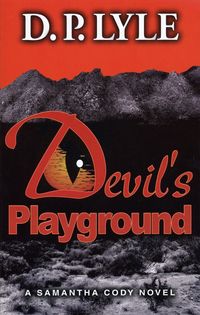
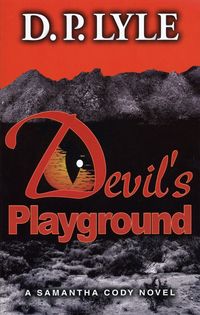
Devils-playground-813x1280 A bunch of my friends have new and out-of-print books that have just been released on the Kindle.

Bill Crider's classic westerns RYAN RIDES BACK and MEDICINE SHOW are out and cheap, too.

Doug Lyle has brought back his Samantha Cody books, including DEVIL'S PLAYGROUND.

And James Reasoner, Bill Crider, and Mel Odom have teamed up under the pen name "Colby Jackson" on RANCHO DIABLO, an original series of westerns, that kicks off with SHOOTER'S CROSS.

Check'em out!

Farewell to the Mystery Bookstore

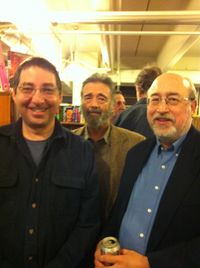
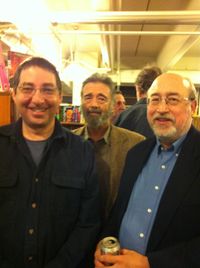
IMG_0057 Tonight, the Mystery Bookstore had their farewell party. It was a bittersweet event. It was great to see so many mystery writers and fans in one room…but sad to see a legendary, independent bookstore close down.


The owners and employees, in their good-byes, observed that they've never met a nicer, more supportive group of people than mystery writers and what a pleasure it was just having the chance to get to know them all.

They're right. As I was looking at all those faces, and talking to all those writers, I was struck by what an incredibly friendly, warm, and out-going group they are…and how much I like them.

Unlike TV, where there is a real class system…you don't see showrunners hanging out with staff writers and treating them as equals… that isn't the case at all among mystery novelists.  Everyone mixes together. The superstars like Michael Connelly and Robert Crais are as friendly, approachable, and supportive as the least-known mid-list writer. They don't just hang out with other writers in the bestseller list. Everyone treats one another with mutual respect. Sure, there are a few in the biz who don't, but those are the exceptions. 

The Mystery Bookstore was like our home, the place where all of us could get together several times a year, like a family gathering for the holidays, and talk shop and catch up with one another. Losing the store is like losing our home. I wonder now how often we'll all get together under one roof now that we've lost the store…my fear is that it will be hardly ever.

The loss of independent bookstores, which are really so much more than just places that sell books, is one of the real, and painful, downsides of the success of the Kindle.

(Pictured: Lee Goldberg, Dick Lochte, Thomas Perry)

You Can Become a Kindle Millionaire, Part 21

The_Walk_FINAL This was, far and away, my best month ever for sales of my out-of-print backlist on the Kindle.

I sold 3075 books and earned $6624.40 in royalties.  My biggest seller was THE WALK, which sold 1083 copies and earned $2230.98.  

I also did nicely on Createspace with the trade paperback editions of my books, earning $483.94 but not-so-well on the Nook, earning  just $211.46 (though I am told B&N was having accounting problems this month and may be adjusting those numbers upwards, as they did in December).

The grand total in royalties for January, not including Smashwords (Apple, Diesel, Kobo, Sony) or Amazon UK sales, is $7319.80.

By comparison, in January 2010, I sold 536 copies and earned $775 in royalties.

Unbelievable.

(My poorest selling books are the four JURY titles, formerly known as the .357 VIGILANTE series. I blame that, in part, on the negative reviews they've received due to sloppy proofreading. No matter how many times I've gone through the books, errors still seem to slip past me. So the books are now in the hands of a professional copyeditor…when she gets them back to me I will relaunch the books, give way free copies for fresh reviews, and update the product descriptions). 

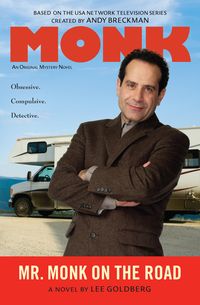
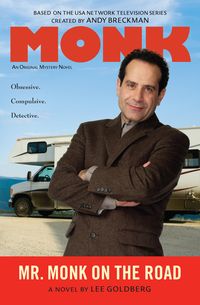
Mr. Monk on the Road Raves

MR MONK on the Road (1)

Two rave reviews for MR. MONK ON THE ROAD just came my way, both from long-time fans of the books. Debra Hamel at Bookblog says, in part:

Goldberg’s books aren’t only about the crimes. More important are the series’s wonderful characters. The development of Monk and Natalie’s relationship over the series makes for many sweet moments, but in this outing the focus is on Ambrose’s interaction with Monk and Natalie and with the world at large. As usual in the series, there is some very funny dialogue. Usually this is centered on Monk’s abhorrence of all things unsanitary, but Ambrose’s social ineptitude also makes for some funny lines. I really enjoyed this one and the series as a whole, and I’m hoping the books never stop coming. 

Ed Gorman liked it for a lot of the same reasons. He says, in part:

Lee Goldberg has cast the new and extremely enjoyable Monk book as a picaresque adventure.[…]I’ve given up trying to rank the Monk books. I’ve read them all and think they each have different pleasures to offer, which is a tribute to Lee’s savvy as a writer. But I have to say that putting both the Monks in a RV with Natalie-take-no-crap-Teeger has got to be the funniest premise yet. A truly hilarious read with a surprise shout-out to the movie “Duel” coming out of nowhere. Among many other surprises.

Thank you Ed and Debra for the great reviews and the continued support!